
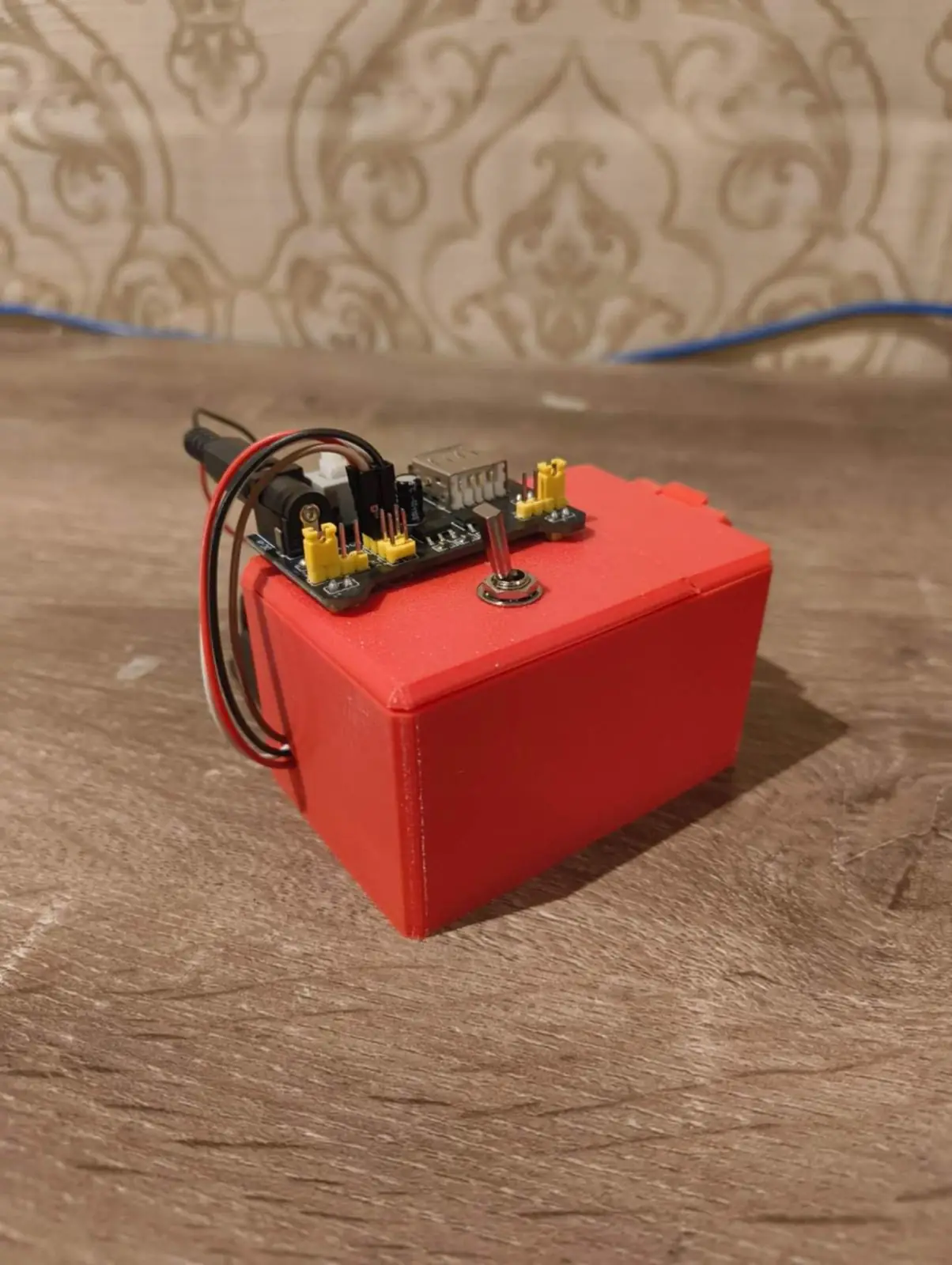
Rebellious Box
Students explore the fundamentals of circuits and motor control by building a machine with a surprising personality that fights back to turn itself off!
Contact Us
Curriculum
Students engineer their own "Rebellious Box", an automated device that turns itself off when activated. This project combines mechanical design, electronics, and programming to create an amusing yet sophisticated automated system. Students develop comprehensive engineering skills by writing their own Arduino code, designing mechanical systems, and troubleshooting complex hardware-software integration challenges.
Subject Content
- Electronics & Circuit Design
- Programming & Coding (Arduino/C++)
- Mechanical Assembly
- Systems Integration
- Tool, Component and Work Safety
Course Outcomes
- Understand Arduino programming fundamentals (variables, functions, conditionals, loops)
- Control actuators and electronic components programmatically
- Debug hardware and software issues systematically
- Apply engineering design principles (requirements, testing, iteration)
- Understand cause-and-effect in automated systems
- Understand I/O relationships
Curriculum Alignment
The Rebellious Box project has been mapped against both the Western Australian Curriculum (WACE) and the Victorian Curriculum F–10 (VCAA), covering Years/Levels 3–4 through 9–10. Full mapping tables — content codes, project application and general capabilities — are available to download below.
Western Australian Curriculum
Maps to Design & Technologies, Digital Technologies and Science across Years 3–4, 5–6, 7–8 and 9–10 — covering the design process, materials and components, safe production techniques, and evaluation of the finished mechanical build.
WACE MappingVictorian Curriculum F–10
Maps to the Critical and Creative Thinking capability across Levels 3–4, 5–6, 7–8 and 9–10 — showing how iterative build, test and refine cycles develop questioning, reasoning and reflective thinking.
VCAA Mapping