
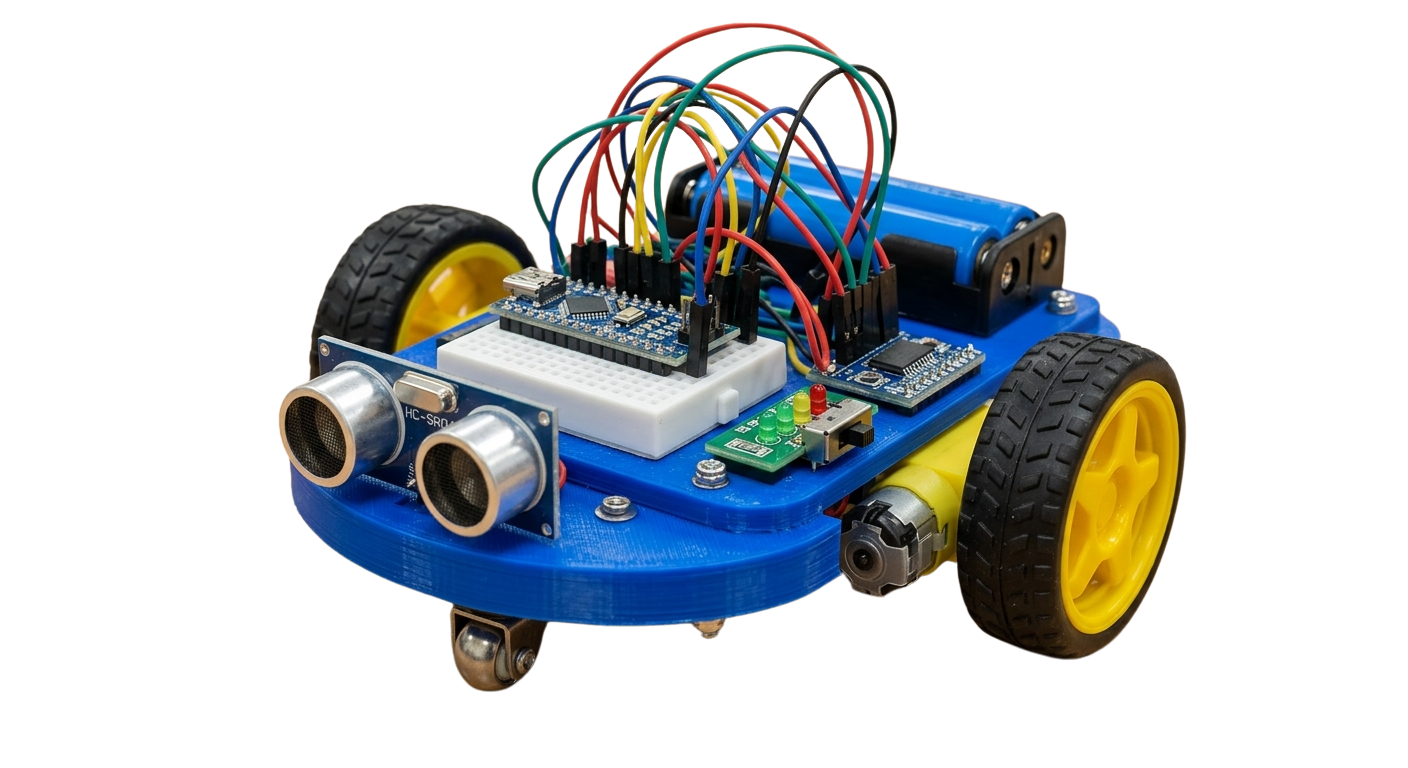
Autonomous Robot Car
A hands-on STEM project where students design, build, and program an Arduino-powered robot capable of driving around and avoiding obstacles autonomously. From assembling the physical chassis and wiring power distribution systems to coding motor drivers and ultrasonic distance sensors, students experience authentic engineering design while bringing their custom robot to life.
Contact Us
Curriculum
Students build and code a self-driving robotic car from the ground up using an Arduino microcontroller, custom motor driver electronics, and ultrasonic distance sensors. Following the same development stages as real robotics engineers; mechanical design, electronics wiring, software programming, sensor integration, and iterative refinement, students bridge the gap between hardware and code. They begin by constructing the drive mechanism and wiring rechargeable power circuits. As their coding skills develop, they create motion control libraries with pulse-width modulation (PWM) and write reactive decision-making algorithms that allow the vehicle to perceive obstacles and navigate independently.
Subject Content
- Mechanical Assembly & Design: Constructing a 3D-printed chassis, mounting N20 gear motors, attaching wheels, brackets, standoffs, and a front caster wheel.
- Electronics & Power Engineering: Reading circuit diagrams and safely wiring 18650 lithium batteries, USB-C TP4056 charging boards, DC-DC boost converters, power switches, and battery indicators.
- Motor Control & Drive Mechanics: Understanding DC motor operations, gear reduction, torque, H-Bridge drivers (TB6612FNG), differential drive steering, and PWM speed modulation.
- Sensors & Perception: Installing HC-SR04 ultrasonic sensors, measuring speed-of-sound timing, understanding fields of view, and handling sensor dead zones.
- Embedded Programming (Arduino/C++): Master structure with setup() and loop(), pin definitions, variables, constants, reusable functions with parameters, and serial monitor debugging.
- Control Logic & Algorithms: Implementing conditional statements (if/else), comparison operators, boolean logic, threshold logic, and reactive navigation routines.
- Engineering Process & Quality Assurance: Systematic testing, code refactoring, state-based logic, tuning turn angles and detection distances, and hardware debugging.
- Work Safety & Best Practices: Safely handling rechargeable batteries, breadboard jumper wiring, hardware assembly, and electrical safety standards.
Course Outcomes
- Build & Power a Mobile Platform: Mechanically assemble chassis components and safely construct a multi-voltage DC power management system.
- Program Motion Control: Code custom differential drive movement libraries (forward, backward, left, right, stop) using PWM speed control.
- Integrate Sensor Feedback: Interface ultrasonic sensors to capture real-time distance measurements from surrounding obstacles.
- Develop Autonomous Navigation: Write decision-making logic enabling the vehicle to evaluate its surroundings and avoid collisions autonomously.
- Apply Iterative Refinement: Debug software bugs, refactor code structure, and fine-tune turning precision and threshold distances.
- Customise & Showcase: Enhance the robot with custom features (e.g., status LEDs, buzzers, dynamic drive modes) and demonstrate system performance on an obstacle course.
Curriculum Alignment
The Autonomous Robot Car project has been mapped against both the Western Australian Curriculum (WACE) and the Victorian Curriculum F–10 (VCAA), covering Years/Levels 3–4 through 9–10. Full mapping tables — content codes, project application and general capabilities — are available to download below.
Western Australian Curriculum
Maps to Design & Technologies, Digital Technologies and Science across Years 3–4, 5–6, 7–8 and 9–10 — covering systems thinking, sensors and control, algorithmic decision-making, safe assembly of the chassis and electronics, and evaluating autonomous behaviour.
WACE MappingVictorian Curriculum F–10
Maps to the Critical and Creative Thinking capability across Levels 3–4, 5–6, 7–8 and 9–10 — developing questioning, reasoning and reflection as students design, test and refine the robot's sensing and navigation logic.
VCAA Mapping